Over time, cryptocurrency assets such as Bitcoin wallets can be forgotten or lost. They may still exist on old computers and laptops, external drives or backups, but locating them can be a daunting task. That’s where Treasure Hunter comes in. This powerful application is designed to scan storage devices and uncover cryptocurrency-related data by analyzing files at a deep level. Forget endless manual searches: let Treasure Hunter help you recover your digital wealth with ease!
An advanced crypto & Bitcoin wallet finder
Most software relies on superficial scans and searches for known filenames in predefined locations. This approach quickly breaks down in real-world scenarios. Treasure Hunter goes far beyond simple filename matching by inspecting the actual contents of each file to determine whether it contains cryptocurrency data. As a result, it can uncover hidden, obscured or corrupted wallets that traditional software fails to detect.
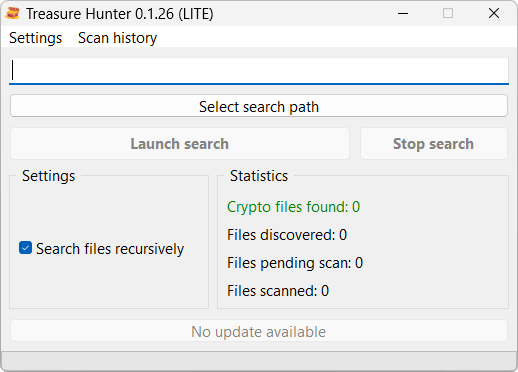
Supported crypto wallet formats and private keys
Treasure Hunter can find wallet files generated by the following software:
| Software | Information |
|---|---|
| Bitcoin Core & derived | Detects Berkeley DB and SQLite3 databases, which are often named wallet.dat. Forks like Litecoin Core, Dash Core and Dogecoin Core are supported. |
| Electrum & derived | Identifies JSON-formatted wallets and private key dumps (JSON/CSV). Forks like Electrum-LTC, Electron Cash, Dash Electrum and Electrum-DOGE are supported. |
| Multibit Classic & MultiDoge | Discovers BitcoinJ and key export files, often identified by the extensions .key, .wallet and .wallet.cipher. |
| Multibit HD | Scans for .wallet.aes and .zip.aes files. |
| Blockchain.com | Recovers the JSON files created by this software, including files whose name ends with wallet.aes.json. |
| Bither | Detects the unique signature of this SQLite3 database, typically named address.db. |
| Wasabi Wallet | Parses the JSON files created by this privacy-centric wallet software. |
| MyEtherWallet | Recovers the modern JSON Ethereum keystore files as well as the older proprietary JSON files generated by this wallet software. |
| MyEtherWallet CX | Locates Chromium database fragments related to this wallet software. |
| Sparrow Wallet | Recognizes H2, JSON and encrypted files generated by this software. |
| BitPay/Copay | Detects Chromium database fragments related to this wallet software. Also parses JSON backup files whose name often ends with -Copaybackup.aes.json or -BitPaybackup.aes.json. |
| Armory | Identifies signature associated with its proprietary .wallet file format. Also recovers .frag files and keylist exports. |
| Atomic Wallet | Locates Chromium database fragments related to this wallet software. |
| Coinomi | Locates Chromium database fragments related to this wallet software. |
| Coin Space | Locates Chromium database fragments related to this wallet software. |
| Guarda | Locates Chromium database fragments related to this wallet software. Also recovers backup files, whose name often ends with -guarda-backup.txt. |
| Exodus | Scans for the seed.seco files, the JSON files (typically named passphrase.json) and the Chromium database fragments generated by this software. |
| mSIGNA/CoinVault | Uncovers Boost serialization files and SQLite3 databases, often identified by the extensions .priv, .acct, .vault and .vault.all. |
| PyWallet (Joric) | |
| PyWallet (Ranaroussi) | |
| FreeWallet | Locates Chromium database fragments related to this wallet software. |
| Crypto.com Onchain & Desktop Wallet | Locates Chromium database fragments related to this wallet software. |
| BlockStream Green | Recovers the JSON wallet files from this software. |
| Jaxx Liberty | Locates Chromium database fragments related to this wallet software. |
| MetaMask | Locates Chromium database fragments related to this wallet software. |
| KryptoKit | Locates Chromium database fragments related to this wallet software. Also detects JSON backup files, often named backup.json. |
| GreenAddress | |
| BitApp Wallet | Locates Chromium database fragments related to this wallet software. |
| BitClip | Locates Chromium database fragments related to this wallet software. |
| Bitcoin Browser Wallet | Locates Chromium database fragments related to this wallet software. |
| Ethereum Wallet & Mist Browser | Uncovers JSON Ethereum keystore files. Also detects Ethereum presale wallet files, often named ethereum_wallet_backup.json. |
| Etherwall | Discovers JSON Ethereum keystore files. |
Treasure Hunter also detects:
| Format | Information |
|---|---|
| WIF keys | Recovers unencrypted private keys for Bitcoin, Bitcoin Cash, Litecoin, Dash, Zcash, Dogecoin, etc. |
| BIP38 keys | Identifies passphrase-encrypted private keys. |
| HD private keys | Locates master private keys (xprv, yprv and zprv) used in Hierarchical Deterministic (HD) wallets. |
| Mini private keys | Recovers the mini key format used by Casascius physical coins. |
| BIP39 seed phrases | Detects seed phrases of 12, 15, 18, 21 and 24 words. Also known as mnemonic phrases, backup phrases, recovery phrases or secret phrases. |
| Ethereum keystore files | Finds JSON keystore files generated by many wallet software such as Ethereum Wallet and MyEtherWallet. Also referred to as UTC keystore files. |
| Ethereum presale wallets | Uncovers original JSON wallet files from the 2014 Ethereum crowdsale. |
| BitcoinJ wallets | Detects files created by this popular Java-based library. Used by many software, including Multibit Classic and Hive Wallet. |
Download Treasure Hunter for free
Treasure Hunter is available on Windows, Mac and Linux.
Windows
The following versions of Windows are supported: 7, 8, 8.1, 10 and 11.
If you are unsure which version of the software to download, try the 64-bit version first; if it doesn’t launch, try the 32-bit version.
- Download the 64-bit version
- Download the 32-bit version (Unavailable right now)
Mac
Linux
GTK 2 and OpenSSL 1.x or 3.x are required to run Treasure Hunter.
Frequently asked questions
Can I run Treasure Hunter on a computer without Internet access?
Absolutely! Treasure Hunter does not require an Internet connection to work. You can run it on a fully offline computer if that’s what you prefer.
Does Treasure Hunter collect any information?
By default, Treasure Hunter collects analytics to help improve the software, but this is entirely optional. You can disable this behavior at any time and your scans will continue to work exactly the same.
Is Treasure Hunter’s source code available on GitHub?
No. That being said, both the Windows and Mac versions are digitally signed for your security. Moreover, the software does not require an Internet connection to work.
What types of storage devices can Treasure Hunter scan?
Treasure Hunter can search for crypto wallet files on a wide range of storage devices. This includes hard drives (HDDs and SSDs), USB keys and SD cards; as well as optical media like CDs, DVDs and Blu-ray discs.
Can cryptos be recovered from a reformatted, wiped or damaged storage device?
Yes, but your mileage may vary since its original data is likely to be corrupted. You will need to use data recovery software to reconstruct the device’s filesystem, then search it with Treasure Hunter. To prevent further damage, avoid repeatedly recreating the device’s filesystem. Instead, create a byte-to-byte backup – also called a disk image or clone –, which can be safely converted into a filesystem multiple times if necessary. Follow this in-depth tutorial for more details.
How can I speed up Treasure Hunter?
There are many variables that can influence Treasure Hunter’s scanning speed – too many to list them all. However, a common issue for Windows users is real-time antivirus protection, especially from the built-in Windows Defender. Because Treasure Hunter performs deep-level analysis on file contents to identify cryptocurrency data, antiviruses often flag this intense activity as suspicious, slowing the scan to a crawl. If you trust Treasure Hunter, you can significantly improve its performance by adding it to your antivirus exclusion list.
If I find Bitcoins on someone else’s storage device, do they belong to me?
No. Simply finding Bitcoins does not grant ownership. Legal implications vary depending on how and where you discovered them, so it’s best to consult a lawyer.