If you have spent any time trying to get back into a cryptocurrency wallet, you have almost certainly come across hashcat, John the Ripper (JtR) and BTCRecover. They are the three names that surface in every forum thread on the subject, and deservedly so, as they are excellent tools. So when Treasure Hunter gets mentioned alongside them, it is fair to wonder whether it is simply another contender for the same job.
It isn’t. Treasure Hunter belongs to a different category of software, and it deals with a problem that sometimes comes up before cracking ever begins. The distinction is worth understanding, so let’s delve into it.
What hashcat, John the Ripper, and BTCRecover do
All three are password crackers. You feed them something encrypted – a wallet hash extracted with a tool such as bitcoin2john.py,
a BIP38-protected private key, a passphrase-protected seed, etc. – and they test password candidates until the correct one
is found. Each has its own strengths:
-
hashcat is built for speed. It leans on your GPU, supports hundreds of hash modes, and offers a full range of attack modes: straight, rule-based, combinator, mask-based brute force, and hybrid.
-
John the Ripper, especially the jumbo build, is the swiss-army knife of password cracking: its
*2johntools (multibit2john.py,bitcoin2john.py,electrum2john.py, etc.) extract crackable hashes out of encrypted files, and it supports more formats than any other cracker while running CPU-native. -
BTCRecover was written with cryptocurrencies in mind. It understands wallet formats natively, and it is at its best when you remember most of a password or seed phrase and only need to fuzz the parts you are unsure about.
Despite their differences, they all operate within the same constraints. The odds of success depend on the size of the keyspace you are searching, on the quality of the masks, rules and wordlists you can give them, and on the key-derivation function protecting the wallet or secret.
There is also something all three take for granted, which is that you already have the encrypted wallet file or secret you wish to crack. That assumption does not always hold.
Finding and cracking are two different steps
In many lost Bitcoin cases, the cracking stage is never reached because the wallet file or the secret is missing. You cannot run a password-cracking tool against something you do not have.
Consider the following fictitious early adopter. They bought a few coins a decade ago on a laptop that has long since been
retired, and its drive now sits in a drawer or was copied onto a backup and forgotten. The wallet might be a wallet.dat
file, an Electrum JSON file, an Ethereum keystore, a WIF key saved in a text file, or a Chromium database fragment left
by a browser extension. It may have been renamed, buried in a forgotten folder, partly corrupted, or hidden on purpose.
In theory, they could look for it by hand, searching for known filenames such as wallet.dat. In practice, I don’t
recommend it. It is easy to miss a wallet or secret, and this approach does not scale: with several drives holding
millions of files each, they would be looking for a needle in a haystack.
What Treasure Hunter does instead
Treasure Hunter is a wallet finder, not a password cracker. It scans storage devices and inspects the contents of every
file it finds. It recognizes dozens of formats, from the Berkeley DB and SQLite3 databases used by Bitcoin Core to
Electrum JSON files, Armory .wallet files, Multibit key exports, Ethereum keystores, and the Chromium fragments left
by browser wallets such as MetaMask. It also detects secrets such as WIF keys, BIP38 encrypted keys, HD master keys,
mini private keys, and BIP39 seed phrases of 12 to 24 words.
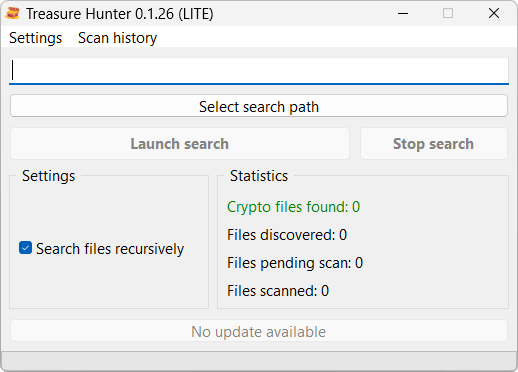
What Treasure Hunter does not do is break encryption. If it comes across a wallet or a secret, it will tell you what it found; and that is where hashcat, John the Ripper, or BTCRecover take over. The two kinds of tools sit at different stages of the cryptocurrency recovery process.
Using them together
Once you stop thinking of them as competitors, the workflow becomes straightforward:
-
Scan your drives. Point Treasure Hunter at every device you own, not just your main computer. That means external drives, old USB keys, SD cards, burned CDs and DVDs, retired laptops, and the like.
-
Review the results. Treasure Hunter tells you what kind of files it found, and that becomes your roadmap.
-
If needed, crack your wallet or secret. If they are encrypted and you don’t know the password, this is where you use a password cracker.
One more possibility is worth keeping in mind. A thorough scan will sometimes turn up an unencrypted copy of the very wallet or secret you were preparing to brute-force: it could be found in a temporary file, a crash dump, or an old backup synced to the cloud. This is admittedly a long shot, but when it happens, the password-cracking problem disappears altogether.
Final thoughts
hashcat, John the Ripper, and BTCRecover are the right tools once you are holding an encrypted wallet or secret. Nothing here is a criticism of them. They were simply never meant to answer the question: where is your wallet or secret? Treasure Hunter answers that one. Scan your devices, find out what you have, and only then decide what needs cracking.