Whenever I advertise Treasure Hunter online, someone inevitably calls it a scam. And fair enough: the cryptocurrency space is indeed riddled with scammers. On top of that, my software claims to find lost Bitcoin, so how is it any different from the countless wallet finders, key generators, and balance checkers that do nothing but sell a pipe dream to naive users (or worse, rob them of the few coins they hold)?
In this article, I will address this question directly. I will explain what Treasure Hunter does, what it cannot do, and how to run it in a way that makes trusting me, the developer of the application, unnecessary.
What does Treasure Hunter claim?
Treasure Hunter is a wallet scanner, or wallet finder. To tell an honest one from a misleading one, let’s look at what they each claim.
How most wallet scanners operate
Most wallet scanners work by randomly generating cryptocurrency secrets (such as seed phrases or private keys) and checking whether they lead to any funds. Technically, it is not a scam, because there is a theoretical possibility that a generated secret unlocks real funds. In practice, those odds are 1 in 115,792,089,237,316,195,423,570,985,008,687,907,853,269, 984,665,640,564,039,457,584,007,913,129,639,936. Simply put, you are significantly more likely to win the Powerball jackpot, get struck by lightning on the way to collect your winnings, and then get struck by a meteorite on the way home.
These scanners rely on the fact that humans struggle to grasp probability on an exponential scale. That is where the dishonesty often lies: not in the software, which does exactly what it claims, but in the marketing around it, which never puts a number on your chances of success and quietly lets you assume they are real.
How Treasure Hunter operates
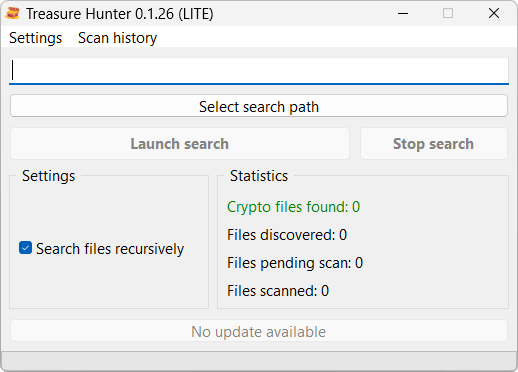
Treasure Hunter takes a different approach. You see, when a cryptocurrency secret is generated, it has to be stored somewhere, and that is usually a file sitting on a storage device like an HDD, SSD, or USB key. You tell Treasure Hunter which storage device to search, and it scans the contents of every file on it to determine whether any of them contain such a secret. In other words, it does not try to generate a secret that leads to funds (a hopeless exercise); instead, it looks for the ones that already exist.
This is where Treasure Hunter’s claim stops. There is no algorithm in my software that conjures Bitcoin out of a drive that never held any. Treasure Hunter only claims a thorough search; if the drive never held a secret, the search will come up empty.
How can you use Treasure Hunter without trusting me?
Treasure Hunter does not require an Internet connection to work. It does not need one to scan a drive, to display results, or even to activate a paid license. You can install it on a computer that has never been online, or simply unplug the network cable before launching it, and it will work just fine. I do not merely allow this: in fact, I recommend it. Running Treasure Hunter on an air-gapped computer gives you two things at once:
-
Protection against me. If the software cannot reach a network, then nothing it finds can leave your machine. Whether I am trustworthy stops being part of your decision to use Treasure Hunter.
-
Protection against everybody else. If you are searching a drive for cryptocurrency secrets, you should assume the computer you are using may be compromised. An air gap defends your findings against any malware that might be present.
Who is behind Treasure Hunter?
Scams depend on anonymity. A legal name is a liability when you are stealing from people, which is why you so rarely find one attached to this kind of software.
Treasure Hunter’s binaries are signed by DigiCert on Windows and by Apple on Mac. To obtain these certificates, I had to provide government-issued photo identification to both companies. Your operating system checks that signature every time you launch the software, and should a single byte of the binary have been modified after signing, it will refuse to run.
Moreover, I have been publishing under my own name on this blog for years, and you are welcome to look around. You will even find a “Dance” category containing videos of me, on camera. These videos demonstrate I operate publicly, with a face and a reputation attached, rather than anonymously.
Frequently asked questions
Do I have to pay to try out Treasure Hunter?
No. Treasure Hunter comes with a free LITE license. It detects all crypto files, with no results omitted, though some file paths might be masked; revealing them requires a paid license. The LITE version is limited to 10 scans and is restricted to personal, non-commercial use on your own private devices.
Why isn’t Treasure Hunter’s source code available on GitHub?
I am an independent developer, and Treasure Hunter is part of how I make a living. Publishing its source code would mean giving away my product. Sure, open-sourcing it would be stronger evidence that I am hiding nothing – but only for readers who actually inspect the code and compile it themselves, which almost nobody has the time to do.
The offline guarantee described in this article is stricter in practice: it does not ask you to audit my intentions; it removes my ability to act on them. Plus, the signed binaries confirm that the software you run is the software I built.
Why does my antivirus flag Treasure Hunter?
Because Treasure Hunter performs deep-level analysis of file contents to identify cryptocurrency data, antiviruses may flag this intense activity as suspicious. Windows Defender is the most common culprit. Usually the software is not blocked outright; instead, the scan slows to a crawl. If you trust Treasure Hunter, adding it to your antivirus exclusion list will significantly improve its performance.
Will Treasure Hunter recover my cryptocurrencies for me?
No. Treasure Hunter is an application built to locate cryptocurrency files, not to access or recover them. When it detects one, it indicates which patterns triggered the match, telling you what you are looking at and giving you a hint about how to access it. What happens next is up to you. Some users handle access and recovery on their own, while others prefer expert guidance. I do offer specialized recovery services, and I mention it here so that you know where my incentives lie.