If you have discovered or inherited a card featuring the ₿ symbol and the label bitbills, you may be holding a significant piece of history. These cards were some of the first physical Bitcoin (BTC) collectibles ever created, predating even the most iconic physical artifacts known today, such as Casascius Coins. Created by Douglas Feigelson in 2011, Bitbills had a brief production run that ceased in 2012. Because they are no longer in circulation, they have become incredibly rare and are highly sought-after by collectors.
However, there is something you must understand immediately: the value of your card could be far more than its cheap exterior suggests. These cards were “loaded” over a decade ago with a digital currency called Bitcoin. Given the massive increase in Bitcoin’s price since 2011, a card originally worth only a few tens or hundreds of dollars could be worth millions of dollars today.
If you have come across one of these cards, this guide will explain how to assess its worth and, more importantly, how to handle it properly so you don’t accidentally lose the fortune it might hold.
First of all, what is Bitcoin?
Bitcoin is a currency, like the US dollar or the Euro. That is, it can be used to buy or sell goods and it can be exchanged for other currencies. Bitcoin does have a few key differences that set it apart from traditional currencies, but for the purpose of this article, you don’t need to understand all of them. However, you should know that:
- Bitcoin is primarily a digital currency. You need to be comfortable with technology.
- Bitcoin is decentralized. That is, it works without central authorities such as governments, banks, or payment platforms. If anything goes wrong, you are on your own.
- Bitcoin transactions are final. Reversals or chargebacks are impossible.
What are Bitbills and how do they work?
While Bitcoin is a digital currency, Bitbill cards give it a physical form. They contain what we call a private key, which is like a password: whoever possesses it has full control over the associated Bitcoins and can spend or transfer them at will.
Identifying your Bitbill card
Bitbill cards were issued in two distinct formats.
Plastic cards
This is the most common format you are likely to encounter.
On the front side, the card features the word bitbills alongside a drawing of a coin containing two ₿ symbols. You will also see the denomination of the card: ₿1, ₿5, ₿10, or ₿20; that is, 1 Bitcoin, 5 Bitcoins, 10 Bitcoins, or 20 Bitcoins. Finally, you will see a small QR code protected by a tamper-evident hologram.
On the back side, you will see a large QR code labeled address, accompanied by a series of alphanumeric characters
starting with the digit 1. You will see another tamper-evident hologram.
To ensure the security of the funds, the private key is hidden within the card. The original instructions on Bitbills' website state, “To get your card’s private key, carefully cut out the square QR code visible on the front of your card. The card should separate into layers. Take the internal QR code square and peel off the security hologram. It may help to use rubbing alcohol and a penny to remove any residue from the hologram.”
Aluminum cards
Aluminum Bitbill cards were also available, although they were much rarer. These were issued as a two-card set, designed to separate the act of receiving Bitcoins from the act of spending them.
-
The payee card: This card contains only the Bitcoin address. It was designed to be shown to others so they could send you funds without any risk to your security.
-
The bank card: This is the high-value asset. It contains the address (in text format) as well as the private key (both in text and QR formats). You must have this card to access the funds.
Are Bitbills worth anything?
Bitbills were issued in denominations of 1, 5, 10, and 20 BTC. To put this in perspective, even the entry-level 1 BTC card has transformed from a tech novelty into a high-value financial asset worth ≈ $69,000 USD as of this writing. Like any rare collectible, they must be handled with extreme care to preserve their value.
How do I know if my Bitbill still has Bitcoins?
To check if your card is still “loaded” with Bitcoins, you do not need to rely on the private key or damage the card in
any way. Instead, you will use the Bitcoin address, which is a string of alphanumeric characters starting with the digit 1.
Because the Bitcoin network is a public ledger, anyone can use this address to look up the status of a Bitbill card online.
Locating the address on your card
If you own the plastic card, the address is printed on the back side. It is labeled address and accompanied by a large, exposed QR code.
If you own the aluminum cards, ensure you are looking at the payee card. The address label is visible on both sides: one side displays it as a QR code, while the other provides it in plain text. If you do not have the payee card, you may find the address on the bank card, but be sure not to mix it up with the private key, which could have disastrous consequences.
Steps to check the balance
Once you have your Bitcoin address, go to the blockchain explorer from Blockchain.com.
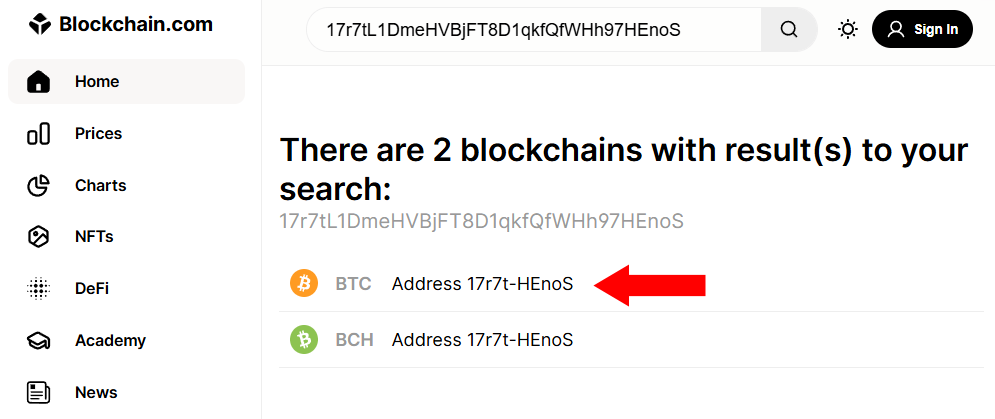
At the top of the screen, you will see a search bar. Input your address. We will use 17r7tL1DmeHVBjFT8D1qkfQfWHh97HEnoS
as an example.

The blockchain explorer may ask you to confirm the cryptocurrency for your address. Select BTC.
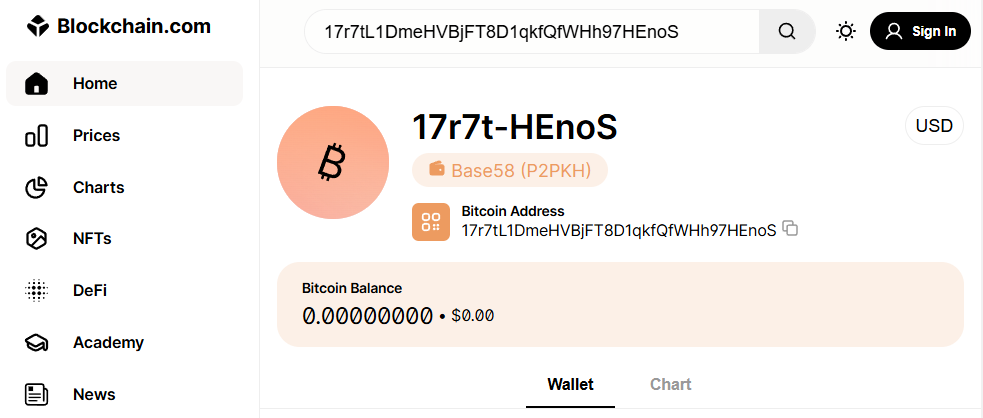
Look at the balance section. As of this writing, we see that the address doesn’t contain any BTC. Thus, the card with which it is linked is not “loaded” anymore.
What should I do with my Bitbill?
Your next steps will depend on whether your Bitbill card still holds its digital value.
If the card is empty
While discovering an empty card is disappointing, the physical object itself is not worthless. Because Bitbill cards are iconic artifacts from the earliest days of Bitcoin, a dedicated market exists for them. Many collectors are eager to purchase redeemed cards simply to own a piece of cryptocurrency history. While the proceeds likely won’t fund your retirement, these cards still command a respectable price as collectibles.
If the card is loaded
Redeeming a Bitbill card involves moving the funds from the physical card to a digital wallet, a hardware device, a cryptocurrency exchange, or a long-term storage solution like a seed plate. This process also involves claiming various “forks” – separate cryptocurrencies like Bitcoin Cash that were created throughout Bitcoin’s history – which might be valuable on their own.
However, I must be very direct about the stakes: even a 1 BTC card represents a life-changing sum of money. At these price points, following a generic “how-to” guide is risky. Bitcoin transactions are irreversible; a single typo, a compromised computer, or a minor oversight could result in the total loss of your fortune.
Furthermore, the “correct” way to handle your Bitcoins depends on your goals. Do you want to sell them for cash immediately? Do you want to hold them for another ten years? Or perhaps a mix of both? Each path requires a different approach to ensure the maximum level of security.
My professional redemption & security services
If you are uncomfortable handling your Bitbill card, I offer a professional service to manage the entire redemption process for you. I will ensure your assets are moved with zero exposure to security threats or technical errors, and in accordance with your goals. I also ensure you don’t leave money on the table by identifying and claiming “forked” coins – such as Bitcoin Cash – that have accrued on your address over the last decade.
I charge a 5% fee on the redeemed coins. I do not charge any upfront, flat, or hourly fees; my business model is entirely commission-based.